
One True Scotsman
From pony litigation to a leaky dishwasher.

In October 1854 my great-great-great-grandfather found a brown pony on his property. He hired solicitors.
The No True Scotsman fallacy is the move you make to protect a stereotype from a counterexample. You hold a picture of a Scot in your head: dour, thrifty, suspicious of show, canny to the point of meanness, Presbyterian to the bone, litigious when his interests are crossed, slow to part with money and slower to forget being short-changed. Someone produces a generous, sunny, open-handed Scot who buys the next round without checking the time. You say: “No true Scotsman would.” The fallacy edits out the exception so the picture stays clean.
Antony Flew named it in the seventies, but the move is older than philosophy. You may know it better as moving the goalposts. You believe the stereotype, you meet the counterexample, you tighten the rule. The goalposts shift; the cliché walks on, undisturbed.
It is why politicians reach for it. A standard that moves every time it is tested cannot be met, and cannot be failed.
My great-great-great-grandfather destroys the fallacy. Alexander Murdoch is the stereotypical True Scotsman made flesh. I find this more familiar than is entirely comfortable.
Alexander Murdoch was born at Hallhill, in the parish of Old Monkland, on 17 December 1799. He was a tenant farmer at Hilton, in the parish of Cadder, north of Glasgow. He died there sixty-five years later, at twenty past three in the morning on 13 October 1865, of typhoid fever with jaundice. The son who signed as informant on the death certificate was the Reverend Alexander Murdoch, minister of Loch Ryan near Stranraer. He was the eldest son, named after his father, who had been named after his.
That is the foundation of Alexander’s story. The rest is in the papers.
Start with the pony. He found it on his property in October 1854, and there is no record of how it got there. The neighborly response would have been to ask around. The lazy response would have been to keep it.
Alexander Murdoch hired solicitors.
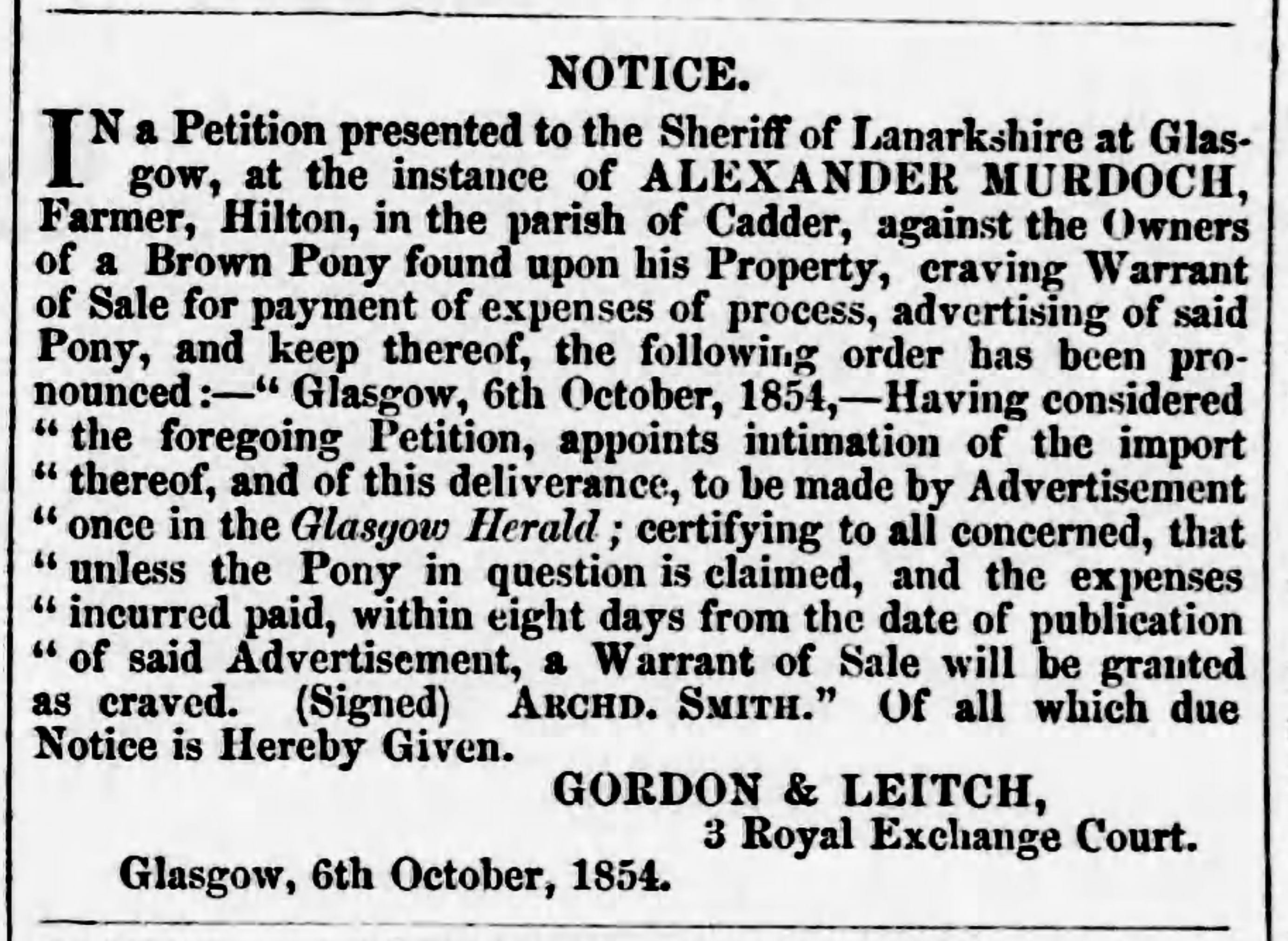
Notice of Petition, Alexander Murdoch v. Owners of a Brown Pony. Glasgow Herald, October 1854.
The firm was Gordon & Leitch, of 3 Royal Exchange Court, Glasgow. They drafted a petition to the Sheriff of Lanarkshire, and on 6 October 1854 the Sheriff pronounced an order: notice was to be advertised in the Glasgow Herald, and unless the pony’s owner came forward and paid the expenses incurred (the cost of process, of advertising, and of keep) within eight days of publication, a Warrant of Sale would be granted as craved.
The recursion deserves a moment. He had found the animal, and he could not advertise it without incurring expense, and he could not recover the expense without advertising it, and he could not sell the pony without an order of court. So he went to court to obtain an order, to advertise, to recover the cost of going to court. The pony was the collateral.
There is no possible outcome of this proceeding in which Alexander loses money on the pony.
The pony was not an isolated case. The Herald carried at least two other notices placed by him, both about livestock, both filed under his name at Hilton. In both, Alexander is making sure he does not lose money on an animal.
In one, he is the aggrieved party. Twenty-two black-faced tup hoggs and one black wether Leicester hogg, with two crosses, had been stolen or strayed from his farm at Hilton, near Bishopbriggs. A reward was offered to whoever could provide information leading to recovery. Information was to be given to him directly, or to a Mr James Coubrough at Blairlummock, Campsie. He had thought through the logistics.
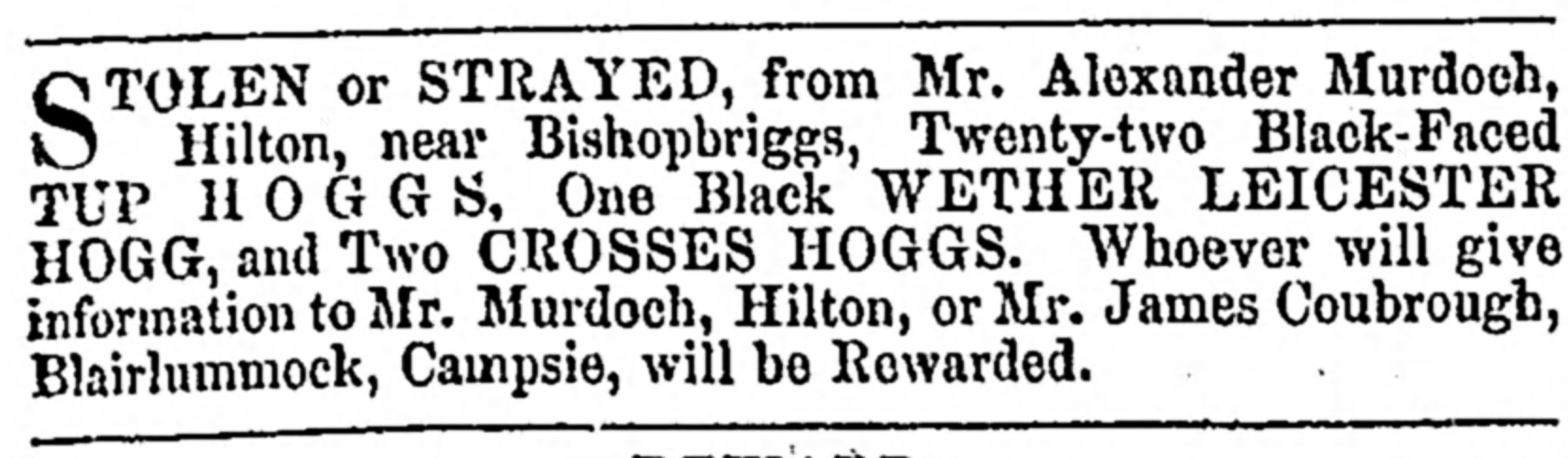
Stolen or Strayed notice, Alexander Murdoch, Hilton. Glasgow Herald, 9 March 1855.
In the other, he is the finder. About a score of sheep had appeared on Hilton Farm, near Cadder. The owner could have them back on proving his property and paying expenses. Apply to Alexander Murdoch, Hilton.
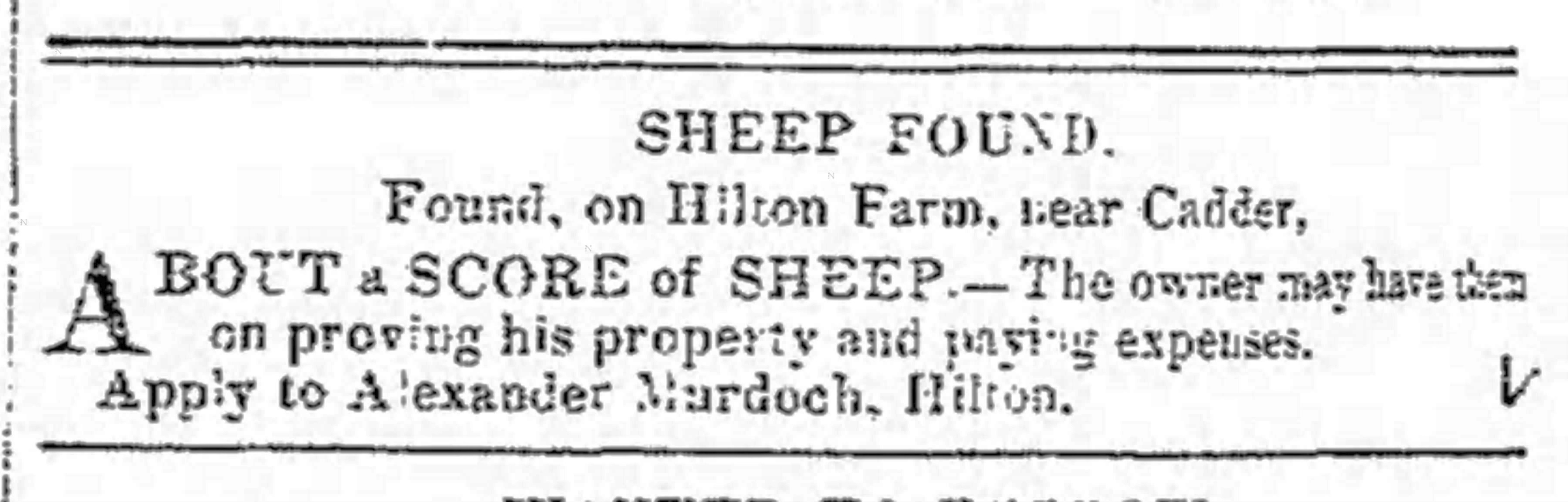
Sheep Found notice, Hilton Farm. Glasgow Herald, 14 August 1848.
These are not the same incident. In one he has lost twenty-three sheep and would like them returned. In the other he has acquired about twenty and would like to be paid for keeping them. The principle is the same. Alexander Murdoch was not going to feed another man’s sheep, and he was not going to lose his own.
When he died in October 1865, the inventory of his personal estate ran to four full categories. The first item is almost too on the nose for a parsimonious Scot. Cash in the house: £1. Not “about a pound,” not “a small sum on the premises.” A pound.
Someone had counted it.
The rest is what you would expect of a man who counted:
Household furniture: £47, 8s 6d. Appraised by a licensed appraiser named John Slater, because of course it was.
Farm stock and implements of husbandry: £782, 5s 6d. Appraised by the same.
£50 owed by a grain merchant on Cambridge Street.
£163 from the City of Glasgow Bank, with interest tidily entered to the date of death.
£51 in half-years’ rent from property at 70, 72 and 74 Rutherglen Loan. He was a landlord as well as a farmer.
£250 lent to the Union Railway Company, being the price of property at Saltmarket the deceased had sold to the company. He had sold them the land and lent them the purchase price.
The total personal estate was £880, 14s, of which exactly £1 was within reach.
The settlement itself had been executed by him on 12 September, three weeks before he died. The codicil was annexed by the executors on 14 October, the day after death, and the whole thing registered at the Sheriff Court at Hamilton on 27 October. A typhoid fever with jaundice that runs three weeks gives a man time to put his affairs in order, and he had used the time. He did not die intestate. He died, in short, with his books closed.
The other thing the documents tell you about Alexander Murdoch is that the Murdochs of Lanarkshire kept marrying Bowmans, and saw no reason to stop.
His father, also Alexander and also a farmer, had married Isobell Bowman at Old Monkland in 1792. She was from the Cambuslang Bowmans, the daughter of a James Bowman who farmed there. The marriage produced a working farm and a stable household, which were the things a marriage was for.
So in December 1827, four days short of his twenty-eighth birthday, Alexander married Martha Bowman at Barony. A different Bowman family (Martha was from Middlequarter, in the Calton, daughter of John Bowman and Martha Law), but a Bowman nonetheless. He had married, in essence, his mother’s surname. Whatever objection might have been raised does not appear in the record. The marriage produced thirteen children and forty-six years of tenancy at Hilton.
The system was working.
In October 1875, ten years after his own death, Alexander’s son Robert Graham Murdoch came back to Old Kilpatrick with a motherless daughter. I have written in a previous piece about his years on the Demerara, and the two wives he buried in those years. What he did next was what his father would have done, and what his father’s father had done before that: he married a Bowman. Janet Bowman of Old Kilpatrick, no relation to either of the previous two. A third Bowman, a third Murdoch generation, a third parish.
He had a method for getting his life back on track, and he used it. Both Alexanders certainly would have approved.
You could explain this as demographics. Lanarkshire farming families drew from a small pool; surnames recur. The Murdochs would not have explained it. They would have said the method worked.
Try the fallacy on Alexander Murdoch and watch what happens. Did he take a stray pony to the Sheriff Court? He did. Did he keep £1 in the house and £250 out on loan to a railway company? He did. Did he advertise lost sheep in the Herald and then again found sheep, to avoid incurring any financial loss? He did. Did he marry his mother’s surname, send his eldest son to the kirk, and die three weeks after settling his estate, at twenty past three in the morning of a typhoid fever he had clearly been outlining a response to? Yes.
The picture stays clean. There is nothing to edit out. Alexander Murdoch is the One True Scotsman.
He is also, I should note, my great-great-great-grandfather, and the line is not entirely broken. I once took Whirlpool Corporation through what I can only describe as a sustained correspondence over a leaky KitchenAid dishwasher, and came away with compensation, a formal written apology, and a shiny new KitchenAid stand mixer.
Nothing better than piecing together the real story behind archival material.