
Providence
I went to Guyana in 1993. My great-great-grandfather got there first.

In 1993 I spent three months in Guyana on a Raleigh International expedition. We built a school in Lethem on the Brazilian border, renovated a coastal hospital for patients with Hansen’s disease (historically called leprosy), and did archaeological work at Fort Nassau on the Berbice River. I was nineteen.
We flew into Timehri International, four years before it was renamed Cheddi Jagan, and drove north along the East Bank Public Road. The airport sits south of Georgetown on the east bank of the Demerara River, and the road threads the old sugar belt: villages, drainage ditches, cane fields stretching back from the road on the inland side, the river hidden behind a strip of houses to the west. It was less developed than it is now. I remember disembarking the plane and being hit by an intense humidity that my Scottish heritage was ill-suited for.
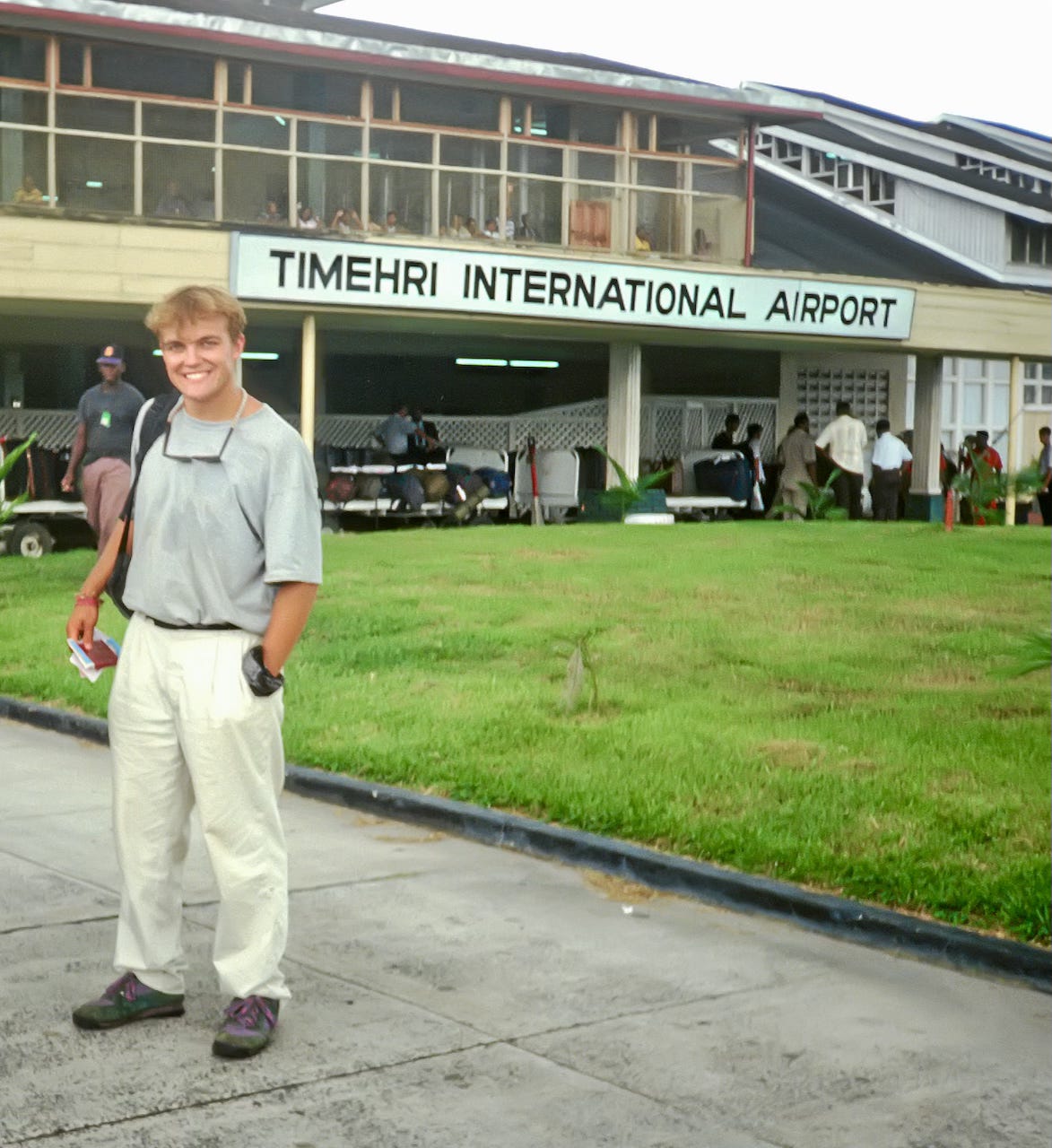
Timehri International Airport, Guyana, 1993. End of the expedition.
What I did not know, and would not learn for thirty years, was that one of those villages had once been a sugar estate called Providence, and that in 1867 a Scotsman of twenty-five had taken up his post there as manager.
The path to it ran through ancestry research. I’d been working through my family lines properly; first-party documents, parish registers reaching back to the early 1600s, the statutory records Scotland has kept since 1855; names and dates cross-checked against the source. When I got to my great-great-grandfather, the record showed three marriages in close succession. I assumed I’d conflated two men with the same name and went back to verify.
Three marriages, one man.
Then I looked at where the second one had taken place. Georgetown, British Guiana. That had to be a mistake too. I went back again.
Three marriages, one man, and a stretch of years on the Demerara coast.
His name was Robert Graham Murdoch. He was born in Cadder, Lanarkshire, in 1842, a few miles from the Old Kilpatrick parish where Murdoch and Bowman families would intermarry across at least three generations. He had grown up on the doorstep of Glasgow, in a Scotland whose shipyards were rising on the Clyde and whose young people were going out to staff the Empire. He had married Elizabeth Noble Houstoun earlier that year at Plantation Lusignan, a different estate further along the coast. By 1869 he was running Providence.
The records of 1869 are sparse but they are not silent. In May, Elizabeth died at twenty-eight; the death is registered at Lamaha Street in Georgetown. That same year, in July, the shovel gang at Plantation Leonora on the West Coast struck over withheld wages, the first of a wave of disturbances across the Demerara estates among the indentured Indian laborers who cut the colony’s cane. In November, Robert remarried, to Mary Uranie Hounslow, in Georgetown. They had a daughter in 1871. Mary returned to the UK and died in London that December at twenty-one, two and a half years after Elizabeth. The daughter, Martha, survived. Robert took her home to Old Kilpatrick and four years later married my great-great-grandmother, Janet Bowman.
That is what the records say. They do not say what he carried with him on the boat home from Demerara, and I do not propose to imagine it.
Placing myself on his ground took some work. I went to the maps to align my 1993 route with his: Lusignan, Providence, Georgetown, the East Bank Public Road. I dug out the slides I’d taken on the expedition, scanned years ago, and matched what I’d photographed against the coast as it is now. Gemini filled in the plantation’s own history.
What I can say with certainty is the geography. Providence sat on the East Bank of the Demerara, on the road that connects the airport to Georgetown. The estate is gone; the village name remains, and the cane lands have become other things. But the line on the map is the same. In 1993 I drove through what had once been his ground. I had no idea. I went on to Lethem, and to Georgetown, and to the Berbice. He had stayed where I was passing through until two wives were dead and a daughter was old enough to travel.
The interval was a hundred and twenty-six years. The road was the same road.
I don’t want to make more of this than it is. It isn’t reincarnation or design or a hand on the tiller. It is a coincidence. But coincidences have shapes, and the shape of this one is a stretch of tarmac on the East Bank of the Demerara. The same line of road, two Murdoch arrivals, a hundred and twenty-six years between them. He came for sugar. I came to build a school. Neither of us knew about the other when we landed.
I know about him now.
This is the kind of thing I keep finding. The records of the analog century are still in reach, the people who knew the people are still living, and the tools have caught up with the records. We are the generation that can bridge back. There are more echoes than I had expected.