

Cousin John
Family lore, parish registers, and the unhelpful intervention of mathematics.

My family said we were descended from John Milton. Not Milton-something. Milton himself. The Milton. Paradise Lost, blind in old age, dictating to his daughters, buried at St Giles Cripplegate. That Milton.
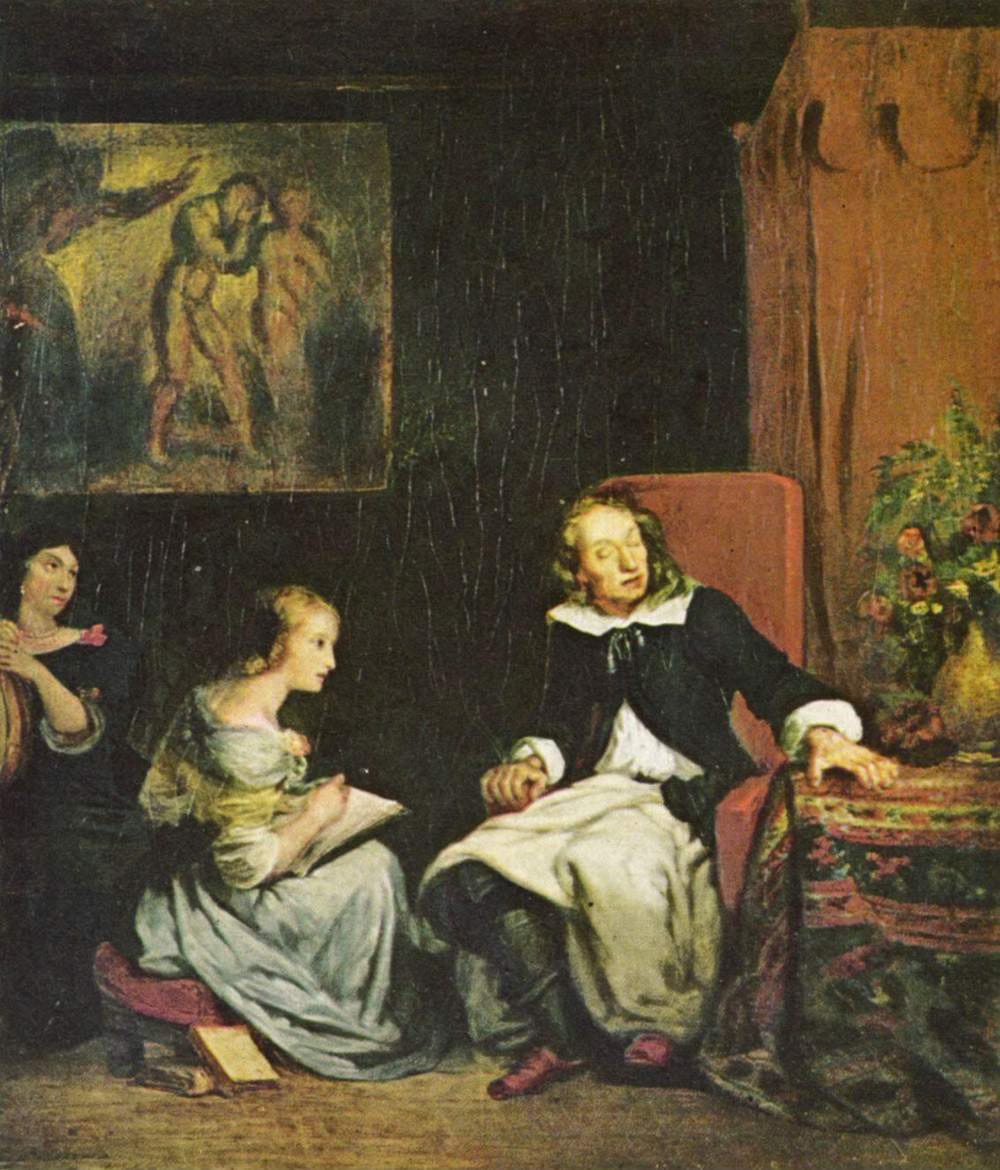
Milton dictates to his daughters, by Eugène Delacroix, (Public Domain Image)
The claim came down via my grandmother, who’d had it from her grandparents, and she passed it on the way you’d pass on a slightly suspicious heirloom; with a raised eyebrow and the implicit understanding that you were free to make of it what you wanted. She was acerbic and funny and would have enjoyed what follows.
The route ran through her mother’s line, the Woolleys, back through the Andrews and the Hawes and eventually to a Sarah Milton, born in Harefield in 1813, who married into the line at St Marylebone in 1835. From Sarah you climb backward through three more generations of Miltons in Ickenham and Ruislip (William, William, James) until you arrive at a John Milton baptised at St Botolph without Aldersgate, in the City of London, on 30 March 1705. That John is the hinge. Everything before him is the question.
The Ancestry tree, when I first got stuck into it, was confident. It linked our John to a father, also John Milton, born in Richmond, Surrey in 1680. From there it leapt three more generations and landed squarely on Sir Christopher Milton, the poet’s younger brother, the Royalist lawyer, Baron of the Exchequer under James II. From Sir Christopher to his brother John is one short step. The chain looked, on first inspection, like a chain.
Then you start pulling on the chain. Or rather, you ask an AI to help you pull on it, and then you spend a weekend checking what it finds, because AI is exactly as confident as Ancestry and exactly as wrong, until you make it look at the actual documents.
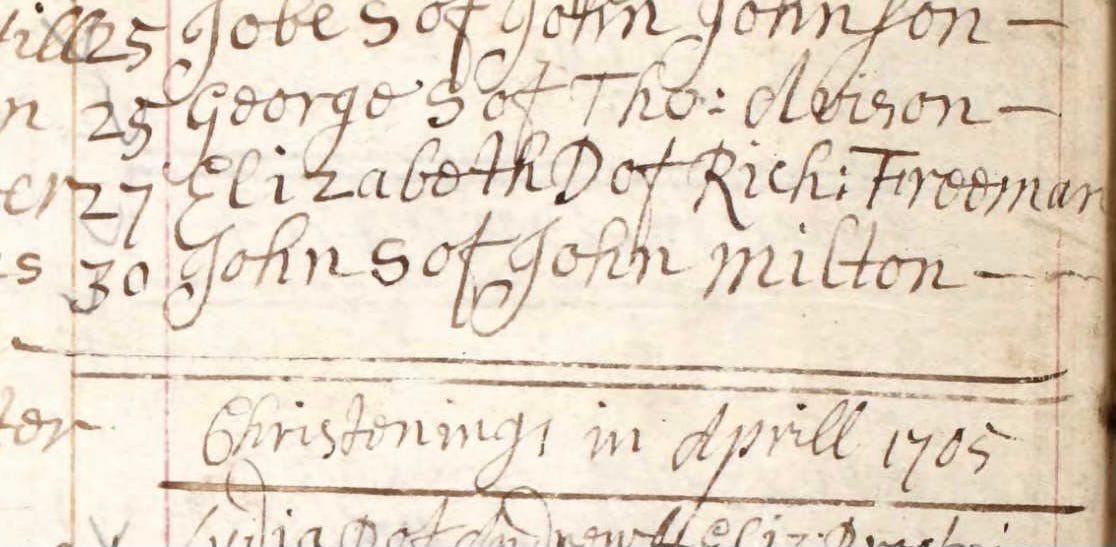
St Botolph without Aldersgate, parish register, 30 March 1705. London Metropolitan Archives
The 1705 baptism entry, when you find the actual image, is four words long. “John, son of John Milton.” No mother named, no occupation, no honorific. Sir Christopher had been knighted nineteen years earlier; any grandson of his baptized in a London parish would have been entered as “Mr.” or “Gent.” at minimum. Plain entries belong to plain people. The clerk who wrote those four words was registering a tradesman’s child, not a baron’s.
The Richmond link fares no better. There is a John Milton baptised at Richmond in October 1680, exactly as the Ancestry tree claimed. But when you read the actual parish register (there’s a free transcription on the Internet Archive, edited by a Mr Smith for the Surrey Parish Register Society in 1903), the entry reads “John, son of William Milton.” Not John. William. Ancestry had the date right and the parentage wrong, which is a particular kind of wrong: confident, plausible, and undetectable unless you bother to look. Richmond turns out to have had its own perfectly ordinary Milton family (Robert, William, Alexander, fathering children across four decades) with no apparent connection to the poet’s people at all.
And the poet’s people, it transpires, run out. The standard accounts (David Masson's Victorian biography of 1880, updated by John T. Shawcross in 2004) tell the same story. The poet had one son, who died as an infant in 1651. His brother Sir Christopher had ten children. The sons either died young, died unmarried, or had only daughters. The last possible male-line grandson, a Charles born around 1684, vanishes from the record without a documented marriage. The youngest son, Richard, was a Catholic lawyer who fled to Ireland after 1688 and died there a bachelor in 1713, his probate noting tidily that he left no heirs. The line ends.
So the Ancestry chain was wishful thinking attached to a real baptism. The poet’s line dies with the seventeenth century. The Richmond Miltons are someone else’s family. The Ickenham Miltons appear to be a third unrelated cluster. Our John of 1705 was almost certainly a London tradesman whose father was another London tradesman, and the name Milton was, in the City of London in 1705, just a name.
I should have stopped there. The honest conclusion was on the table: the family story was wrong, and the neatness of the direct line was the giveaway. But I’d already spent a weekend on it, so I kept going, and I started reading about something called pedigree collapse.
Here is what pedigree collapse (a.k.a. implex) says. You have two parents, four grandparents, eight great-grandparents, and so on, doubling each generation. By the time you reach the early 1500s (roughly the era of Richard Milton of Stanton St John, the poet’s grandfather and the deepest Milton our chain even gestures at), you have, in theory, about thirty-three thousand ancestor-slots in that single generation {for the pedantic mathematicians amongst us, yes, ~n=2^15}. The trouble is that there were not thirty-three thousand distinct people available to fill them. There were villages of a few hundred. Cousins married cousins. The tree folds back on itself, again and again, until what looked like a branching structure becomes something more like a braided rope.
The mathematician Joseph Chang worked out the consequences in 1999. For any population that’s been mixing for long enough, you don’t have to go back very far to hit a person who is an ancestor of everyone alive in that population today. For Europeans, the figure is around six hundred years. Anyone living in 1400 with descendants at all is an ancestor of essentially every European alive now. Richard Milton of Stanton St John was born in roughly 1535. He is comfortably inside that horizon.
Which means that if Richard Milton has any living descendants (and he does) he has them in the tens of millions. Anyone of English descent is almost certainly descended from him. So is anyone whose ancestors married into English stock at any point in the last four hundred years, which is most of the Anglophone world. The poet himself, John Milton of Paradise Lost, has no surviving male-line descendants; but his grandfather is an ancestor of, conservatively, half the people I went to school with.
The family story, in other words, is true. Just not in the way it was meant.
What my grandmother passed on, with her raised eyebrow, was not really a claim about descent. It was a claim about membership; membership in a very large and entirely uninteresting club that contains most of England and large portions of the New World. The lore feels specific because it names a specific person. The mathematics is the opposite of specific. It is a way of saying: you, and roughly fifty million others.
This is, I think, the secret embarrassment of amateur genealogy (of which I am most certainly a participant). The further back you push, the less your discoveries belong to you. The Norman ancestor everyone is so proud of is also somebody else’s Norman ancestor, and somebody else’s, and somebody else’s, down the pub and across the road and over the Atlantic. The thinness of the line is the whole point. A tree with thirty-three thousand slots at the top is not really a tree. It is a delivery mechanism for the comforting illusion that you, specifically, came from somewhere.
My grandmother would have enjoyed that.
So I did not descend from John Milton. I am, however, in all probability, descended from his grandfather, along with most of the people reading this. Cousin John, it turns out, is as much your cousin, dear reader, as he is mine.
My wife, meanwhile, is descended from Oliver Cromwell, apparently.
I legit blurted out a laugh at your last sentence... my mom's side of the family ALSO claims we are descendants of Cromwell! There are, in fact, many Cromwells in my tree starting at the great-great grandparent level, but as you noted, it became pretty clear as the line traveled back it was just pointing to a bunch of 'regular' Cromwells :)
The whole time I was reading your essay, I was nodding and relating immensely to your journey, even though I am by no means a mathematician. In my amateur attempts at building trees on Ancestry over the years, the further back I went, the more unruly all the data got, and just didn't seem to add up....using paper and pencil to draw the chronology...so I would pause for a while until I got sucked in again. I find that the branches closest to the ground are the most interesting to explore. These younger history and information clues seem easier to validate and fit into my puzzle... but now maybe I will have to include an AI assistant in my next trip down an Ancestry rabbit hole!
Great observation about the power of math in genealogy. The alternative is the Hapsburg approach to interbreeding that led to deformity and mental issues. As you work back through their line the braided rope becomes a thin thread which was a huge genetic weak link for the ruling family of most of Europe in the early modern period.